Clarifying recipe translations
I’m focusing on translating some recipe ingredients. For "175 g de harina de trigo," it implies bread flour, but in many Spanish recipes, "harina de trigo" is often generic. To avoid confusion, I might use "harina común" or "harina de repostería" for more precision. So, "175 g de harina de repostería" seems correct.
Next, for "100 g cold butter, diced," I’ll go with "100 g de mantequilla fría, en dados." For "1 egg yolk," it translates to "1 yema de huevo," and for "4 tsp cold water," it’s "4 cucharaditas de agua fría."
Finally, for the filling mention, I’ll use "Para el relleno" and adjust "200 g de tocino (bacon) ahumado" for the bacon.Translating ingredients accurately
In Spain, bacon isn’t that common, but to translate "200 g de bacon ahumado," it works to say "200 g de bacon" while adapting for Spanish readers with "200 g de bacon en tiras," since it’s widely labeled in supermarkets.
Next, for "2 spring onions finely diced," it’s "2 cebolletas finamente picadas." The term "cebollín" could be confusing, so I’ll stick with that. For "100 g cherry tomatoes halved," it translates well to "100 g de tomates cherry partidos por la mitad."
For "50 g Gruyère, grated," I’ll keep it as "50 g de Gruyère, rallado," and for "200 ml crème fraîche," it’s just "200 ml de crème fraîche."Translating crème fraîche
I’m considering how to approach translating crème fraîche for Spanish readers. In Spain, it’s often referred to as "crema fresca," while "nata fresca" typically means heavy cream. I think I’ll go with "200 ml de crema fresca" since it’s more recognizable for Spanish cooking.
I wonder if I should stay consistent with using "crema fresca" or stick to "crème fraîche" since both have slightly different connotations. Overall, "200 ml de crema fresca" feels like a solid choice to keep it understandable and relatable for the audience.Translating recipe instructions
I’ve decided to use "200 ml de crema fresca" since that’s widely recognized. For "200 ml double cream," it translates to "200 ml de nata doble." In Spain, it’s more common to say "nata para montar," so I’ll go with "200 ml de nata para montar."
Next, "3 eggs, beaten" becomes "3 huevos, batidos," while "Pinch of ground nutmeg" translates to "Una pizca de nuez moscada molida." For "Salt and pepper," it’s simply "Sal y pimienta."
Then, "2 tbsp fresh parsley chopped" goes to "2 cucharadas de perejil fresco picado."
Finally, I’ll use "Método" for "Method" to keep it consistent. The first step reads: "Para la masa, pon la harina y la mantequilla en un procesador de alimentos y procesa hasta que la mezcla tenga aspecto de migas."Translating cooking method steps
I’m translating steps for a recipe, starting with the first one: "Add the egg yolk and cold water, then pulse again until it comes together into a dough," which translates to "Añade la yema de huevo y el agua fría, y vuelve a procesar hasta que se una en una masa." Then, for "Turn out onto a lightly floured surface," I’ll say "Vierte sobre una superficie ligeramente enharinada, forma una bola y estírala hasta dejarla fina."
Next, I’ll use "Utiliza la masa para forrar un molde para tarta de 23 cm con fondo desmontable, presionando suavemente contra los bordes," and for "Leave a slight overhang," it’ll be "Deja un ligero excedente, recorta y pincha la base con un tenedor."
When it comes to chilling, I’ll mention "Enfría en la nevera durante 10 minutos." For preheating the oven, the translation reads: "Precalienta el horno a 200°C (180°C con ventilador)."
Next, I’ll say, "Forra la masa con papel de aluminio, añade garbanzos para cubrir y hornea 15 minutos." To proceed, I’ll translate, "Retira el papel y los garbanzos y hornea otros 4–5 minutos hasta que esté ligeramente dorada."
Moving to frying, it will be "Fríe el bacon en una sartén hasta que esté dorado; añade las cebolletas en los últimos 2 minutos." For the mixing bowl step, I’ll keep it as "En un bol, bate los huevos, la crema fresca, la nata para montar y la nuez moscada hasta obtener una mezcla homogénea."
When I scatter the toppings on the pastry base, I’ll phrase it as "Esparce los tomates, el bacon cocido, la cebolleta, los tomates cherry asados, el queso rallado y el perejil." Next, "Vierte la mezcla de huevo de manera uniforme.”
For baking, it’s "Hornea a 180°C (160°C con ventilador) durante unos 30–35 minutos, hasta que el relleno esté cuajado pero con un ligero balanceo en el centro."
Lastly, for cooling and serving, it reads: "Deja enfriar ligeramente antes de cortar. Sirve tibia o a temperatura ambiente."
I also need to ensure the structure of the article, with distinct sections for ingredients and methods, including the necessary HTML tags and markup. I’ll keep any requisite empty paragraphs to maintain the formatting.Creating the article structure
I need to restructure the article while keeping the content length similar as requested. The plan is to translate each piece carefully into Spanish, ensuring I maintain the original HTML structure like the <img> tag and section formats.
I’ll start with "
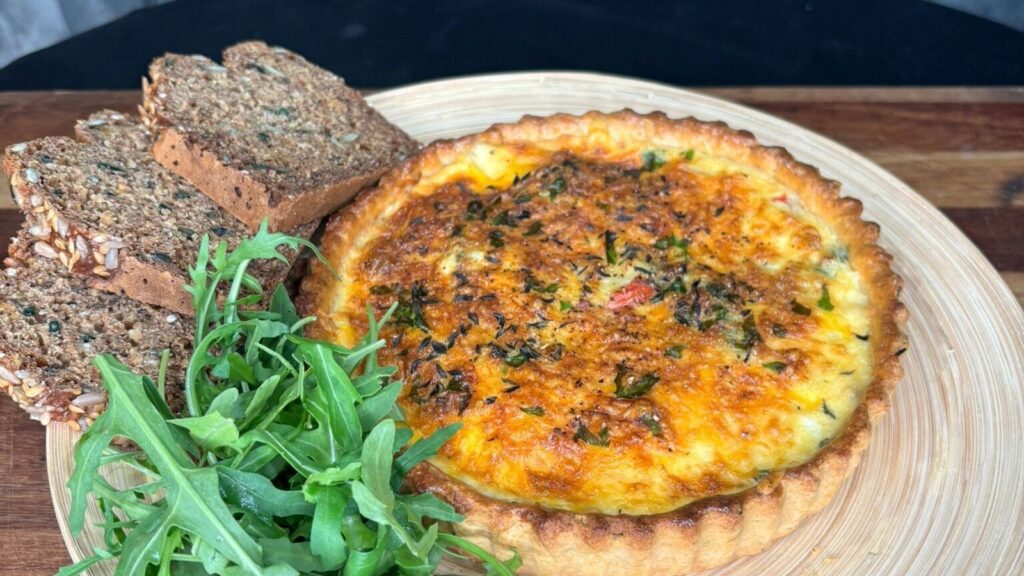
Una quiche ligera y deliciosa.
". Next, I’ll set up the ingredients section, making sure to adapt the titles and maintain the list format.
For example, I’ll say, "
Ingredientes
" and keep, "Rinde 8 porciones." In terms of the ingredients themselves, I have to be careful with terms like "nata para montar," and ensure I’m consistent.
When addressing the method, I’ll break it down step-by-step, ensuring clarity in translation. For example, translating "To make the pastry" to "Para la masa," and preserving the cooking terminology like